
Ear health supplements for construction workers are optional dietary products intended to support everyday wellness, not protect hearing from jobsite noise. This 2026 guide explains where supplements fit, how to check a label, and why hearing protection and prompt care come first.
- Ear health supplements for construction workers do not replace earplugs, earmuffs, or workplace noise controls.
- NIOSH recommends limiting occupational noise exposure to 85 dBA over an eight-hour workday.
- Tinnitus supplements have not been proven to cure ringing or reverse noise-related hearing loss.
- Choose optional ear wellness supplements by their labels, not promises of hearing repair.
Why ear health support matters for construction workers
Construction work puts hearing decisions inside a busy shift: drilling, cutting, demolition, equipment movement, and communication all compete for attention. Your routine needs to work with protective equipment and site procedures, not add another reason to remove hearing protection.
A supplement cannot make an unsafe noise exposure safe. Before comparing ear health supplements, separate nutritional support from hearing conservation. They address different needs.
For your 2026 work routine, the practical priority is reducing noise exposure, using suitable protection, and arranging assessment when symptoms appear. A gummy belongs later in that sequence, if you choose one at all.
Understand the difference between noise limits and supplement claims
The National Institute for Occupational Safety and Health, or NIOSH, recommends an occupational noise exposure limit of 85 dBA averaged over eight hours. Its recommended exposure time halves for every 3 dBA increase: 88 dBA corresponds to four hours, and 91 dBA to two hours.
These are NIOSH occupational-noise recommendations, not a promise that every exposure below a threshold is harmless. They also are not interchangeable with your employer’s applicable legal requirements or site-specific assessment.
For supplement decisions, the National Institute on Deafness and Other Communication Disorders, or NIDCD, states that dietary supplements advertised for tinnitus have not been proven effective. That distinction matters when a wellness label appears beside claims about ringing, hearing restoration, or noise damage.
Build your construction-site ear wellness routine
Start with the actions that address the exposure itself. Then decide whether an optional supplement serves a separate, clearly defined purpose.
1. Check your noise exposure before choosing supplements
Ask your supervisor or safety lead which tasks need hearing protection and whether the site has measured worker exposure. A loud tool used briefly and several noisy tasks across a shift require different exposure assessments; a product label cannot answer either question.
A phone sound-meter app can flag a concern, but it does not replace a suitable workplace assessment. Distance, changing tasks, equipment condition, and the microphone all affect what you measure.
Make this your starting checklist:
- Identify noisy tasks, including work performed by nearby crews.
- Ask for the relevant noise assessment and protection instructions.
- Note when you remove protection to communicate or adjust equipment.
- Report ringing, muffled hearing, or difficulty understanding speech after work.
2. Fit hearing protection around the whole job
Use the hearing protection selected for your task and follow its fitting instructions. Earplugs and earmuffs only help when they fit correctly and stay in place during exposure.
Construction adds practical complications: hard hats, eye protection, dust, gloves, and the need to hear instructions. Raise those conflicts with your safety lead rather than solving them by loosening a seal or repeatedly taking protection off. Ordinary earbuds and consumer noise cancellation are not substitutes for workplace hearing protection.
Before your next noisy task:
- Practice fitting earplugs according to the manufacturer’s instructions.
- Check earmuff cushions, headband condition, and the seal around your ears.
- Confirm compatibility with your hard hat and safety glasses.
- Ask about approved communication methods for the task.
- Replace damaged or dirty protection as directed.
3. Define what you want a supplement to do
Write down the goal before choosing a product. Everyday nutritional support, treatment of a diagnosed deficiency, and relief from persistent tinnitus are different goals. Do not let a general wellness claim stand in for evidence about a medical symptom.
Tinniva ear wellness gummies are best for adults who want an optional daily supplement, not jobsite hearing protection. Tinniva Ear Health Gummies are described as a convenient daily supplement for an everyday ear-health routine. That positioning does not establish that they prevent hearing loss or treat tinnitus.
For your 2026 supplement decision, keep the intended role narrow:
- Choose a specific wellness goal rather than expecting hearing repair.
- Take persistent ringing or hearing changes to a qualified clinician.
- Ask about testing when a clinician suspects a nutrient deficiency.
- Treat convenience as a format benefit, not proof of effectiveness.
4. Read the full label before adding gummies
Start with the Supplement Facts panel and ingredient list, not the front-of-pack promise. Check the serving size, amounts per serving, warnings, and directions. Gummies are a delivery format; they do not tell you whether the ingredients suit your health history.
Tinniva’s ear wellness supplement positioning is not a substitute for reviewing its current label. Bring that label, plus your medication and supplement list, to a pharmacist or clinician if you need help checking suitability. Do not assume an ingredient is present simply because another ear-health product contains it.
Use the same checks for every supplement:
- Read the full ingredient list, including allergens and sweeteners.
- Compare nutrient amounts with supplements you already take.
- Check warnings against your medicines and health conditions.
- Follow the product’s directions rather than increasing the serving.
- Verify any claimed independent testing with the named certifier.
5. Keep your routine separate from symptom care
A supplement routine should be easy to follow without becoming a reason to postpone assessment. If you choose gummies, follow the label and store them as directed, away from children. Their familiar format does not make extra servings harmless.
Keep a simple written record of symptoms and exposures. Record which tasks preceded ringing, whether one or both ears are affected, and whether hearing feels different. That information helps a clinician understand the pattern; it does not diagnose the cause.
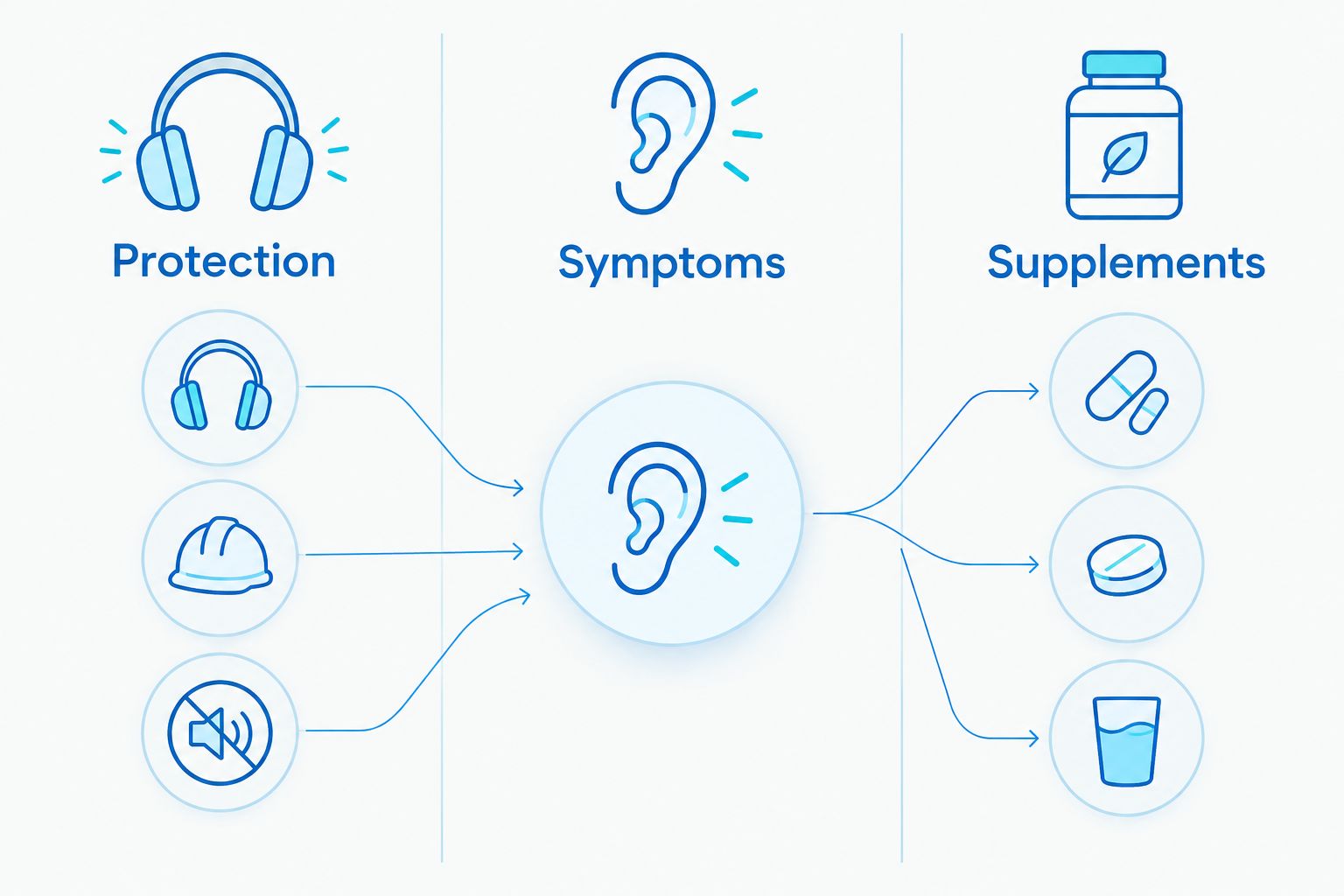
Keep these three decisions separate:
- Protection: follow the site’s noise controls and hearing-protection requirements.
- Symptoms: record changes and arrange appropriate assessment.
- Supplements: review the label and decide whether an optional routine fits.
6. Get hearing changes assessed instead of waiting
Do not wait for a supplement to work when hearing changes suddenly. Sudden hearing loss needs immediate medical attention, including when it feels like a blocked ear or occurs with ringing or dizziness. NIDCD identifies sudden sensorineural hearing loss as a medical emergency.
Persistent ringing, difficulty following conversations, or repeated muffled hearing after work also deserve assessment. An audiologist or other qualified clinician can evaluate hearing and direct next steps; a supplement trial cannot identify the cause.
Put these actions into your 2026 routine:
- Seek immediate medical attention for sudden hearing loss.
- Arrange assessment for persistent or worsening tinnitus.
- Mention ringing that follows your heartbeat or affects only one ear.
- Bring your noise-exposure history and medication list.
- Participate in workplace hearing testing when provided or required.
Compare your options by the job they actually do
The best option depends on the problem you need to address. Noise controls address exposure. Hearing assessment investigates symptoms. Supplements are optional nutritional products, not interchangeable alternatives to either.
Use this comparison to avoid judging unrelated options by the same standard. There is no single purchase that covers every part of construction-site ear care.
| Option | Best for | Practical benefit | Key limitation |
|---|---|---|---|
| Workplace noise controls | Reducing exposure at its source | Addresses the hazard rather than relying only on personal equipment | Requires task-specific planning and employer action |
| Properly selected earplugs or earmuffs | Protecting hearing during noisy tasks | Provides personal hearing protection when correctly fitted and used | Poor fit, damaged equipment, or removal reduces protection |
| Hearing assessment | Investigating ringing or hearing changes | Evaluates hearing and informs appropriate next steps | Does not remove the workplace noise hazard |
| Clinician-directed supplementation | Addressing an identified nutritional need | Matches a supplement decision to an individual assessment | Does not establish that supplementation will resolve tinnitus |
| Tinniva Ear Health Gummies | An optional everyday ear wellness routine | Offers a gummy supplement format | Not a replacement for protection, assessment, or medical care |
| No added supplement | Workers without an identified reason to supplement | Avoids adding another product to review and manage | Does not address a nutritional need if one is diagnosed |
For a worker exposed to loud equipment, protection is the priority. For a worker with new symptoms, assessment is the priority. Choosing no supplement remains a valid decision; you do not need a wellness product to take hearing care seriously.
Common supplement mistakes construction workers make
Treating a gummy as insurance against loud tools
Taking a supplement before a demolition shift does not create a protective buffer. Neither a gummy format nor an ear-health label establishes protection against hazardous sound.
Fix: make your protection decision from the task’s noise assessment. Keep the supplement decision separate, even when the product is marketed specifically around ear wellness.
Waiting through repeated post-shift ringing
Ringing after noisy work is not a useful signal for adjusting a supplement serving. It is a reason to review exposure and seek appropriate assessment, particularly when symptoms recur or hearing changes.
Fix: record the task and symptoms, tell your safety lead about the exposure concern, and arrange care. Do not use symptom changes to decide when hearing protection is necessary.
Choosing ingredients before defining the need
A list of vitamins, minerals, or plant extracts does not establish that the combination is right for you. Advice about correcting a confirmed deficiency also does not prove that extra nutrients benefit someone without that deficiency.
Fix: ask what problem each ingredient is intended to address. Review your diet, medicines, and existing supplements before adding another product.
Increasing the serving when work gets louder
A louder task calls for better exposure control, not a larger supplement serving. More is not automatically safer or more effective, and combining products can duplicate ingredients without making that obvious.
Fix: follow the label exactly. Take questions about overlapping nutrients or medicines to a pharmacist or clinician rather than changing the serving yourself.
Confusing marketing language with treatment evidence
“Ear wellness,” “support,” and “daily routine” describe positioning. They do not demonstrate that a product prevents hearing loss, stops ringing, or repairs damaged hearing.
Fix: look for evidence that matches the exact outcome being claimed. When a claim concerns treating tinnitus or restoring hearing, discuss it with a qualified clinician instead of treating the wording as proof.
FAQ
What are the best ear health supplements for construction workers?
There is no established best supplement for preventing construction-noise hearing damage. Start with workplace noise controls and correctly fitted hearing protection; review any nutritional need separately with a clinician.
Can ear health gummies protect my hearing around power tools?
No, ear health gummies do not replace hearing protection around power tools. Follow your site’s noise assessment and use the protection selected for the task.
Can Tinniva cure tinnitus caused by construction noise?
Tinniva should not be treated as a cure for noise-related tinnitus. It is marketed for everyday ear wellness support, while persistent ringing needs appropriate assessment.
Should I take vitamins if my ears ring after a shift?
Do not use vitamins as your first response to ringing after noisy work. Review your exposure, check your hearing-protection practices, and arrange assessment if symptoms persist or recur.
Are gummies better than capsules for ear health?
A gummy format does not establish better ear-health outcomes than a capsule. Compare the ingredients, amounts, warnings, and suitability rather than assuming the format determines effectiveness.
What should I do if one ear suddenly sounds muffled?
Seek immediate medical attention for sudden hearing loss, even if it feels like blockage. Do not wait for a supplement, a quieter shift, or a routine hearing appointment.
Do I need a supplement if I already eat a balanced diet?
Construction work alone does not establish a need for an ear-health supplement. A clinician can assess a suspected deficiency or another individual reason to supplement.
One last thing
For your next shift in 2026, check the moment when hearing protection comes off—not just the moment when it goes on. Communication problems, uncomfortable fit, and interference with other equipment deserve a practical fix through your site’s safety process.
The most useful ear wellness routine addresses the noise before adding a product. Keep that order when comparing supplements, reviewing symptoms, or planning your next hearing check.