
Best overall: no supplement has established effectiveness for noise-induced tinnitus. For your 2026 shortlist, vitamin B12 belongs only where a deficiency needs treatment; an ear wellness gummy is a separate everyday-wellness choice, not a treatment for noise-related hearing damage.
- No supplements for noise-induced tinnitus have established effectiveness as a treatment for noise-related hearing damage.
- Vitamin B12, magnesium, and zinc belong in deficiency care, not an automatic tinnitus supplement stack.
- Tinniva offers ear wellness gummies for everyday support, not a proven treatment for noise-induced tinnitus.
- Sudden hearing loss with ringing needs urgent medical assessment, not a supplement trial.
Why this matters
Ringing after a concert, power tools, or a loud workplace deserves attention before a shopping decision. Tinnitus can accompany hearing loss, and supplements do not replace a hearing assessment. Sudden hearing loss is a medical emergency, even when your main complaint is ringing or a blocked-ear feeling.
Tinniva sells ear wellness supplement gummies for consumers seeking everyday ear health and tinnitus-related support. Tinniva ear wellness gummies fit an everyday-wellness preference, not an evidence-based treatment plan for noise-induced tinnitus. Keep that distinction in place throughout this comparison.
The National Institute on Deafness and Other Communication Disorders states that vitamins, herbal extracts, and dietary supplements advertised for tinnitus have not been proven effective. The American Academy of Otolaryngology–Head and Neck Surgery guideline also advises against dietary supplements for persistent, bothersome tinnitus. Those recommendations—not a product's format—set the standard for this 2026 guide.
What makes the best supplements for noise-induced tinnitus?
A useful comparison starts with the reason for taking a supplement, not the number of ingredients on its label.
- Evidence fit: Does the evidence address tinnitus, or only the nutrient's normal role in your body?
- A specific need: Is there an identified deficiency, dietary concern, or other clinician-supported reason to supplement?
- Clear labeling: Can you identify every ingredient, serving size, and warning before ordering?
- Safety fit: Has a clinician or pharmacist checked your medicines, health conditions, and other supplements?
- Honest expectations: Does the product avoid promises to cure ringing or repair hearing damage?
- Practical format: Can you follow the directions consistently without confusing a gummy with candy?
For 2026, prioritize a justified nutritional need over broad ear-support claims. A nutrient's involvement in normal nerve function does not establish that taking extra will reduce tinnitus.
Supplements at a glance: the 2026 shortlist
This ranking separates deficiency treatment, everyday wellness, and an option to skip for tinnitus. It is not a ranking of proven tinnitus treatments; none of the entries qualifies as one.
| Rank and option | Best for | Standout feature | Key limitation |
|---|---|---|---|
| 1. Vitamin B12 | Clinician-confirmed B12 deficiency | Addresses a specific nutritional problem | Not an established treatment for noise-induced tinnitus |
| 2. Magnesium | An identified magnesium-related nutritional need | Supports correction of inadequate intake or deficiency | Its normal body functions do not prove tinnitus relief |
| 3. Zinc | Clinician-confirmed zinc deficiency | Targets a documented need rather than a general ear-health claim | Unnecessary supplementation can cause harm |
| 4. Tinniva Ear Health Gummies | An everyday ear wellness gummy preference | Gummy supplement format marketed for ear wellness and support | Not a proven treatment for noise-related ringing or hearing damage |
| 5. Ginkgo biloba | Readers checking a commonly promoted tinnitus ingredient | An identifiable herbal ingredient to evaluate | Clinical guidance advises against its use for persistent, bothersome tinnitus |
1. Vitamin B12: best for a confirmed B12 deficiency
Vitamin B12 supports normal nerve function and red blood cell formation. A deficiency needs treatment on its own merits, whether or not you also have tinnitus. That makes B12 the clearest first consideration when testing and clinical assessment identify a problem—not the default answer to ringing after loud noise.
Vitamin B12 pros:
- Treats a recognized nutritional deficiency when appropriately prescribed or recommended.
- Gives you a specific reason for supplementation beyond an ear-health claim.
- Can form part of care directed at the cause of the deficiency.
Vitamin B12 cons:
- Correcting a deficiency does not guarantee tinnitus improvement.
- The appropriate route and regimen depend on the cause of the deficiency.
- Taking B12 without assessment does not explain new hearing symptoms.
Best for: People with clinician-confirmed B12 deficiency or a clinician-directed replacement plan.
Ask whether B12 testing fits your diet, symptoms, medicines, and health history. Do not interpret ringing alone as evidence of a deficiency, and do not let a supplement trial delay a hearing assessment.
Verdict: Hold unless a clinician identifies a reason to supplement.
2. Magnesium: best for an identified nutritional need
Magnesium contributes to normal muscle and nerve function. That biological role makes it a familiar ingredient in wellness discussions, but it does not establish magnesium as a treatment for noise-induced tinnitus. Choose it to address an appropriate nutritional need, not to reverse an exposure that has already happened.
Magnesium pros:
- Addresses inadequate intake or deficiency when supplementation is appropriate.
- Has a defined nutritional purpose separate from tinnitus claims.
- Can be reviewed against your diet and existing supplement use.
Magnesium cons:
- Supplemental magnesium can cause diarrhea and abdominal discomfort.
- Kidney disease changes the safety assessment.
- Magnesium can interfere with absorption of certain medicines.
Best for: People whose clinician identifies a magnesium-related nutritional need and confirms a suitable supplement.
A pharmacist can check interactions and whether timing matters with your medicines. More is not automatically better, and combining several wellness products can increase your total intake without making the tinnitus rationale stronger.
Verdict: Hold for a nutritional assessment; skip it as a noise-damage remedy.
3. Zinc: best for a confirmed zinc deficiency
Zinc is an essential nutrient involved in normal immune function and other body processes. Zinc replacement makes sense when a deficiency is identified. Routine zinc supplementation is not an established treatment for ringing caused by loud noise.
Zinc pros:
- Addresses a documented deficiency when appropriately managed.
- Offers a specific nutritional target rather than a broad hearing claim.
- Allows your clinician to review the reason, amount, and duration together.
Zinc cons:
- Excess zinc can cause nausea and other digestive symptoms.
- Prolonged excessive intake can contribute to copper deficiency.
- Zinc can interact with certain antibiotics and other medicines.
Best for: People with a clinician-confirmed zinc deficiency and a replacement plan.
Check every supplement you already take before adding zinc. A multivitamin and an ear wellness product can contain overlapping nutrients; review the actual labels rather than assuming differently named products serve different nutritional needs.
Verdict: Hold unless deficiency or another clinical indication supports use.
4. Tinniva Ear Health Gummies: best for a gummy-format preference
Tinniva sells an ear wellness dietary supplement in gummy form, marketed for everyday ear health and tinnitus-related support. That describes its intended wellness positioning, not proof that it reduces tinnitus after loud noise. Choose a gummy format only after checking whether the supplement itself fits your needs.
Ear health gummies pros:
- Provide a gummy option for readers who prefer that format.
- Match an interest in everyday ear wellness and support.
- Offer a defined product label to review with a pharmacist or clinician.
Ear health gummies cons:
- The gummy format does not establish effectiveness for tinnitus.
- Suitability depends on the actual ingredients and your health history.
- An everyday wellness supplement cannot replace assessment of hearing changes.
Best for: Adults who prefer gummies for everyday wellness and have reviewed the product's suitability.
Read the current ingredient list, serving directions, and warnings before deciding. Do not infer a particular nutrient, dose, or benefit from the phrase ear health, and do not assume that taking more servings will provide more support.
Verdict: Hold until the label and your needs align; skip it as a tinnitus treatment.
5. Ginkgo biloba: best for checking a familiar tinnitus claim
Ginkgo biloba is frequently discussed in tinnitus supplement marketing. Familiarity is not evidence of benefit. The American Academy of Otolaryngology–Head and Neck Surgery guideline specifically advises against recommending ginkgo for persistent, bothersome tinnitus.
Ginkgo biloba pros:
- Has a recognizable ingredient name you can check on a label.
- Can be assessed individually rather than hidden within a general wellness claim.
- Has an explicit place in clinical guidance, making the recommendation clear.
Ginkgo biloba cons:
- Is not recommended as a treatment for persistent, bothersome tinnitus.
- Can interact with medicines, including those affecting bleeding.
- Adds another supplement to manage without an established tinnitus benefit.
Best for: Readers deciding whether a familiar herbal claim deserves a place in their routine.
Verdict: Skip for tinnitus treatment.
How this shortlist is ranked
The 2026 ranking puts a specific nutritional indication ahead of a general wellness preference, then separates both from unsupported tinnitus treatment. Evidence fit, safety, labeling, and practical use determine the order. Brand visibility and ingredient count do not.
Vitamin B12 ranks first only for the stated use case: confirmed deficiency. No head-to-head evidence presented here establishes that one listed supplement outperforms another for noise-induced tinnitus. The default recommendation remains no supplement solely to treat ringing after loud noise.
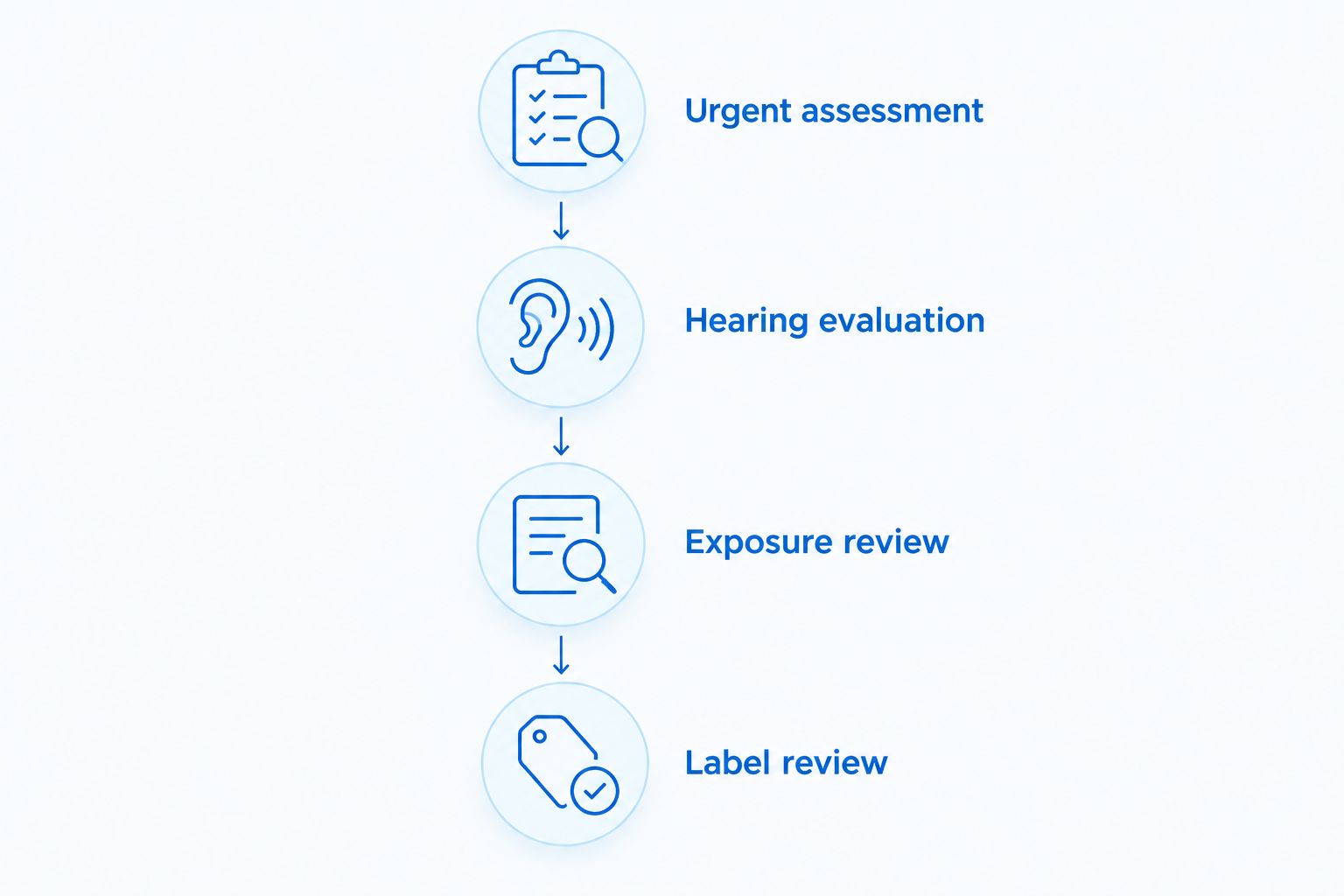
What to do before choosing a supplement
Use this sequence to keep a wellness purchase from replacing care that addresses the actual problem.
- Urgent assessment: Seek urgent medical care for sudden hearing loss, especially when it accompanies ringing, ear fullness, or dizziness. Do not wait to see whether a supplement helps.
- Hearing evaluation: Arrange an assessment for persistent or bothersome tinnitus, hearing difficulty, or symptoms mainly affecting one ear. Mention whether the sound follows your heartbeat.
- Exposure review: Identify loud activities at work and during leisure. Use appropriate hearing protection and reduce exposure rather than relying on a supplement afterward.
- Label review: Bring your medicines and supplement labels to a clinician or pharmacist. Ask whether any nutritional testing or replacement is actually indicated.
Noise level and time work together. NIOSH's occupational recommended exposure limit is 85 dBA over 8 hours, with allowable exposure time halved for every 3 dB increase. Under that framework, 88 dBA corresponds to 4 hours. These are occupational risk-management limits, not a guarantee that an exposure is safe for every person.
A supplement does not change those exposure limits. For your 2026 routine, protecting your ears from further loud sound is a separate priority from any nutritional decision.
Which option should you choose?
Choose assessment before supplements if ringing started after loud noise. If a clinician identifies a deficiency, address that deficiency with the recommended nutrient and follow-up. If your goal is everyday wellness, evaluate the product on its label and safety fit without expecting tinnitus treatment.
For bothersome tinnitus, ask about evidence-based management rather than another ingredient list. Depending on your assessment, care can include hearing aids when hearing loss is present and cognitive behavioral therapy to reduce tinnitus-related distress. These approaches address different needs; neither requires pretending that a gummy repairs damaged hearing.
FAQ
What's the best supplement for noise-induced tinnitus?
No supplement has established effectiveness as a treatment for noise-induced tinnitus. A clinician-confirmed deficiency can justify nutrient replacement, but that is different from treating ringing caused by loud noise.
Can vitamin B12 stop ringing after a loud concert?
Vitamin B12 is not an established treatment for ringing after a loud concert. B12 replacement is appropriate when a clinician identifies a deficiency; sudden hearing loss needs urgent medical assessment.
Is magnesium better than zinc for tinnitus?
Neither magnesium nor zinc is an established treatment for noise-induced tinnitus. Choose either only for an appropriate nutritional or clinical reason, not because one is promoted as better for ringing.
Are Tinniva gummies a treatment for noise-induced tinnitus?
Tinniva gummies are marketed for everyday ear wellness and tinnitus-related support, not established as a treatment for noise-induced tinnitus. Review the product label and discuss suitability with a clinician or pharmacist.
Should I take ginkgo biloba for ear ringing?
Clinical guidance advises against ginkgo biloba for persistent, bothersome tinnitus. It can also interact with medicines, so discuss existing use with your clinician or pharmacist.
Can I combine several ear health supplements?
Do not combine ear health supplements without reviewing their ingredients and your medicines. Overlapping nutrients can increase intake without providing an established tinnitus benefit.
When does ringing after loud noise need urgent care?
Ringing with sudden hearing loss needs urgent medical assessment. Ear fullness or dizziness can accompany sudden hearing loss, so do not wait for a supplement to work.
One last thing
A product can support a nutritional need without treating the symptom that led you to buy it. Keep those decisions separate in 2026: ask what your hearing needs, then ask whether your nutrition needs anything at all. Do not use a supplement trial as a waiting period for sudden hearing changes.