
Best overall: choose only gummies with a verified sugar-free label. Best everyday-wellness candidate to check: Tinniva Ear Health Gummies, not a confirmed sugar-free pick. This 2026 guide separates ear-wellness positioning from the label details you need before buying.
- Choose sugar-free ear health gummies by their current nutrition label, not their product name.
- Tinniva Ear Health Gummies are an everyday ear-wellness candidate, not a verified sugar-free recommendation.
- Sugar-free does not mean calorie-free, carbohydrate-free, or proven to relieve tinnitus.
- For tinnitus support, supplements do not replace a hearing assessment or appropriate care.
Why this matters
Your shopping decision has two separate questions: does the gummy meet your sugar requirements, and does its purpose match your expectations? A product can satisfy one without satisfying the other. Ear-health wording does not establish sugar content, and a sugar-free label does not establish an effect on ear ringing.
For 2026, the right default is label verification before brand preference. If you cannot confirm the sweeteners, serving size, and relevant precautions, pause the purchase rather than filling the gaps with assumptions.
Tinnitus also needs a different standard from everyday wellness. The National Institute on Deafness and Other Communication Disorders states that vitamins, herbal extracts, and dietary supplements advertised for tinnitus have not been proven effective. Treat an ear-wellness supplement as an optional dietary choice, not a tinnitus treatment.
What makes the best sugar-free ear health gummies?
Use these criteria before comparing products. They assess whether a gummy fits your routine; they do not establish that it improves hearing or relieves tinnitus.
- Verified sugar claim: Look for an explicit sugar-free claim supported by the current nutrition information. Do not infer it from fruit flavors or wellness wording.
- Clear serving size: Read amounts per serving, not just per gummy. Your daily intake depends on the labeled serving.
- Complete ingredient disclosure: Check active ingredients, amounts, sweeteners, allergens, and other ingredients before deciding.
- Appropriate health claims: Favor straightforward dietary-support language. Reject promises to cure tinnitus or restore hearing.
- Personal suitability: Consider medicines, other supplements, swallowing needs, and digestive tolerance with a pharmacist or clinician where appropriate.
- Routine fit: Choose a format you can take according to its directions without duplicating ingredients unnecessarily.
A sugar-free badge is an entry requirement for this search, not the final verdict. The rest of the label still matters.
Sugar-free ear-health options at a glance
This shortlist ranks buying routes rather than presenting an unsupported list of competing brands. The named gummy belongs in the ear-wellness category, but its sugar-free status must be established before it qualifies for your shortlist.
| Item or buying route | Best for | Standout feature | Key limitation |
|---|---|---|---|
| Tinniva Ear Health Gummies | Reviewing a named everyday ear-wellness gummy | Dietary supplement positioned around a daily ear-health routine | Sugar-free status is not established here; no tinnitus-treatment recommendation |
| A label-verified sugar-free ear-wellness gummy | Shoppers who require a gummy without a sugar claim mismatch | Explicit sugar-free labeling plus readable ingredient information | A qualifying label does not establish benefits for tinnitus |
| A label-verified sugar-free capsule or tablet | Shoppers willing to leave the gummy format | Lets you compare another format against your dietary requirements | Not a gummy; ingredients and personal suitability still need review |
The order is a checking sequence, not a claim of clinical superiority. Start with the named candidate, apply your nonnegotiable requirements, and change formats if it does not qualify.
1. Tinniva Ear Health Gummies: best for everyday-wellness review
Tinniva Ear Health Gummies are a dietary supplement marketed for everyday ear wellness. The product description presents gummies as a convenient addition to a daily ear-health routine.
That positioning makes the product relevant to this category. It does not establish a sugar-free formulation, a particular ingredient profile, or a benefit for tinnitus symptoms. Keep those questions separate when reviewing the current label.
Tinniva Ear Health Gummies pros:
- The stated purpose directly matches everyday ear wellness.
- The gummy format gives you an alternative to swallowing a capsule.
- The product's daily-routine positioning is distinct from a medical treatment plan.
Tinniva Ear Health Gummies cons:
- Sugar-free status is not verified in this recommendation.
- Gummy format alone tells you nothing about sweeteners or carbohydrate content.
- Ear-wellness positioning is not evidence that the supplement relieves tinnitus.
Best for: Adults reviewing a gummy for everyday ear-wellness support, subject to the label and individual suitability.
Before choosing it in 2026, inspect the complete label for serving directions, sugars, sweeteners, active ingredients, and warnings. If sugar-free is essential, an unclear answer is a reason to wait—not a reason to assume.
Verdict: Hold until the current label confirms your requirements.
2. Verified sugar-free gummies: best for keeping the gummy format
A label-verified sugar-free ear-wellness gummy is the closest match to the search itself. It must satisfy both parts of the description: a relevant dietary-support purpose and an explicit, supportable sugar-free claim.
This is a buying category, not a recommendation for an unnamed formula. You still need to assess each actual product's ingredients and directions before taking it.
Verified sugar-free gummy pros:
- Matches a preference for gummies without assuming every gummy contains sugar.
- Makes sugar labeling a clear pass-or-fail requirement.
- Allows ingredient and sweetener comparisons within the format you prefer.
Verified sugar-free gummy cons:
- Alternative sweeteners still require a tolerance check.
- Sugar-free wording does not establish low carbohydrate content.
- A suitable nutrition label does not prove an ear-health benefit.
Best for: Shoppers whose format preference is firm and who can verify the full label before buying.
If a listing shows only the front of the package, find the complete nutrition and ingredient panels. Do not substitute reviews, product photographs, or a broad wellness description for those details.
Verdict: Buy only after the actual product passes the label and suitability checks.
3. Sugar-free capsules or tablets: best for format flexibility
A capsule or tablet gives you another format to evaluate when a gummy does not meet your requirements. It is not automatically sugar-free or more effective; confirm the actual formulation instead of judging by appearance.
This route is useful when the chewable format matters less than avoiding particular sweeteners or simplifying ingredient comparisons. Any nutritional recommendation should still reflect your needs, not just an ear-health label.
Sugar-free capsule or tablet pros:
- Expands your options beyond chewable supplements.
- Lets you compare formulations without requiring a gummy texture.
- Keeps the decision focused on ingredients, directions, and dietary fit.
Sugar-free capsule or tablet cons:
- Does not meet a strict preference for gummies.
- Can be unsuitable for someone who has difficulty swallowing pills.
- Offers no automatic advantage for tinnitus or hearing outcomes.
Best for: Shoppers comfortable changing formats after a gummy fails their label requirements.
Do not choose an ingredient simply because it appears frequently in ear-health marketing. A clinician can help determine whether a suspected nutritional deficiency needs assessment or treatment.
Verdict: Hold until the formulation and your reason for taking it are clear.
Read the sugar claim correctly
In the United States, FDA rules generally require a food labeled sugar-free to contain less than 0.5 grams of sugars per reference amount and labeled serving, alongside other labeling conditions. Sugar-free is a regulated claim, not a promise of an absolute absence of sugar molecules.
A panel showing 0 grams of total sugars also needs context. Label rounding exists, and you still need to read the serving size, total carbohydrate, ingredients, and any qualifying statements.
Sugar supplies 4 calories per gram, but removing sugar does not necessarily remove every source of calories. A sugar-free gummy can contain other ingredients that contribute energy.
For your 2026 comparison, separate these terms:
- Sugar-free: A claim about sugar content under applicable labeling rules.
- No added sugar: A different claim; it does not necessarily mean sugar-free.
- Total carbohydrate: A broader nutrition measure than total sugars.
- Sweeteners: Ingredients used for sweetness, including alternatives to conventional sugars.
If you manage blood glucose, do not use the front-label sugar claim as your entire decision. Review the full nutrition panel with your healthcare professional when needed.
Check the label before choosing
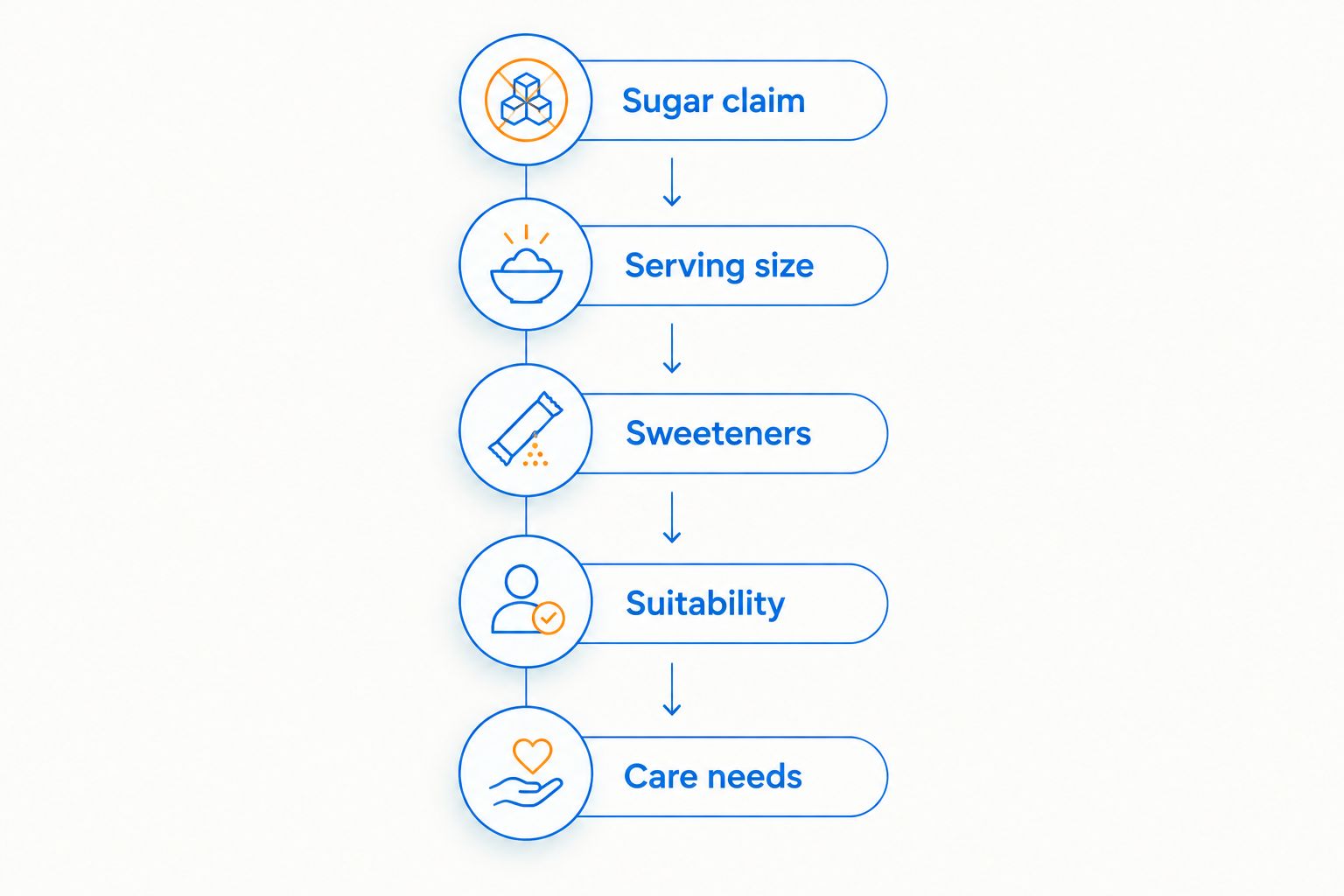
Use this sequence for any ear-wellness supplement. It prevents an appealing product description from answering questions that only the label can resolve.
- Sugar claim: Confirm that the actual package states sugar-free if that is your requirement.
- Serving size: Establish what the listed nutrition and ingredient amounts represent.
- Sweeteners: Read the complete ingredient list, including sugar alcohols where present.
- Suitability: Check warnings, allergens, ingredient overlap, and possible medicine interactions.
- Care needs: Decide whether symptoms need professional assessment rather than another supplement.
Some sugar alcohols can cause digestive discomfort or a laxative effect, particularly when consumed in larger amounts. Read any package warning and consider other foods or supplements containing the same sweeteners.
Avoid stacking supplements casually. If your existing multivitamin and an ear-wellness product contain overlapping ingredients, compare the combined intake with a pharmacist rather than assuming more is better.
How this shortlist is ranked
This 2026 shortlist prioritizes category relevance, verified sugar labeling, ingredient transparency, and personal suitability. It does not rank symptom improvement, because an everyday-wellness description does not establish a treatment effect.
The named product is a candidate for label review. The alternative routes explain what to do if that candidate fails a requirement. No product earns a sugar-free recommendation from its name alone.
Which option should you choose?
Choose a gummy only when its current label confirms the sugar claim and its ingredients fit your needs. If the label is incomplete or unclear, wait or compare another product rather than weakening your requirements.
If tinnitus relief is your main objective, put assessment ahead of supplement shopping. Sudden hearing loss, especially with ringing or dizziness, needs urgent medical attention. Ringing that follows your heartbeat also warrants medical evaluation.
The 2026 default is simple: verify first, supplement second, and never substitute a gummy for needed care.
FAQ
What's the best sugar-free ear health gummy?
The best fit is a gummy whose current label verifies sugar-free status and whose ingredients are appropriate for you. No named product in this guide earns an unconditional sugar-free recommendation.
Are Tinniva Ear Health Gummies sugar-free?
This guide does not verify that Tinniva Ear Health Gummies are sugar-free. Check the current package's sugar claim, nutrition information, and complete ingredient list before choosing them for that requirement.
Can sugar-free ear health gummies stop tinnitus?
Sugar-free labeling does not establish that a gummy can stop tinnitus. The National Institute on Deafness and Other Communication Disorders states that dietary supplements advertised for tinnitus have not been proven effective.
Does sugar-free mean there are no carbohydrates?
No, sugar-free does not mean carbohydrate-free. Read total carbohydrate, serving size, and the ingredient list rather than relying on the front-label claim.
Are sugar-free gummies easier on your stomach?
Sugar-free gummies are not automatically easier on your stomach. Some sugar alcohols can cause digestive discomfort or a laxative effect, so check the sweeteners and package warnings.
Are capsules better than gummies for ear health?
The format alone does not establish better ear-health results. Compare the actual ingredients, dietary requirements, swallowing needs, and professional advice relevant to you.
Should I take ear-health gummies with my multivitamin?
Check for overlapping ingredients before combining an ear-health gummy with a multivitamin. A pharmacist can help review your total intake and possible interactions with medicines.
One last thing
The most useful package detail is often the serving size, not the largest claim on the front. Photograph the full label before adding a supplement to your routine; it gives you a practical reference when discussing ingredients with a pharmacist or clinician.
A gummy belongs in your routine only after its label answers your questions. A reassuring product name is not a substitute.