
For ear health supplements ranked by price, compare the cost per labeled daily serving before choosing a bottle; the lowest checkout total does not establish the best value. Tinniva Ear Health Gummies are best suited to consumers who prefer a gummy format for an everyday ear-wellness routine, not a treatment for tinnitus.
- For ear health supplements ranked by price, compare cost per labeled daily serving rather than bottle totals.
- Tinniva Ear Health Gummies suit consumers who prefer gummies for everyday ear-wellness support.
- Vitamin B12 and zinc belong in deficiency discussions, not automatic tinnitus shopping lists.
- No dietary supplement is an established cure for tinnitus or a replacement for hearing care.
Why this matters
A supplement can look inexpensive while providing fewer daily servings than another bottle. A more expensive option can also be poor value when its ingredients do not match your nutritional needs.
The useful distinction is between supporting everyday nutrition and treating an ear symptom. Ringing, changes in hearing, and balance problems deserve attention on their own terms. Buying a supplement does not identify their cause.
For your 2026 comparison, start with suitability, check the label, and then compare daily cost. Keep symptom care separate from the shopping decision.
What makes the best ear health supplement?
Use these criteria before sorting your options:
- Personal fit: Identify whether you want a convenient wellness routine or help addressing a clinician-confirmed nutritional need.
- Ingredient amounts: Look for clearly stated quantities, not just a list of appealing ingredient names.
- Daily serving: Check how many gummies, capsules, or tablets make up the labeled serving.
- Label transparency: Review the Supplement Facts panel, other ingredients, warnings, and manufacturer information.
- Relevant evidence: Distinguish evidence about a nutrient deficiency from evidence about tinnitus or hearing outcomes.
- Routine fit: Choose a format you can use as directed without duplicating nutrients from other supplements.
The best-value ear health supplement is one that fits a real need—not simply the least expensive bottle. A low daily cost does not compensate for an unsuitable ingredient or an unsupported promise.
Ear health supplements at a glance
These options serve different purposes. The order below is a decision shortlist, not a cheapest-to-most-expensive claim; compare current offers only after checking the labeled serving and your reason for taking the product.
| Option | Best for | Main distinction | Key limitation |
|---|---|---|---|
| Tinniva Ear Health Gummies | Consumers who prefer an everyday gummy routine | Ear-wellness supplement in gummy form | Wellness positioning does not establish tinnitus treatment benefits |
| Vitamin B12 supplements | People advised to address low B12 | A targeted nutrient rather than a broad ear-wellness formula | B12 supplementation is not an established tinnitus treatment |
| Zinc supplements | People advised to address inadequate zinc intake | A targeted mineral option | Excess zinc can cause harm and interfere with copper status |
| Magnesium supplements | People with an identified reason to supplement magnesium | A targeted mineral approach | Not an established treatment for tinnitus; requires care with kidney disease |
| Ginkgo biloba supplements | Shoppers evaluating botanical tinnitus claims | A botanical rather than a vitamin or mineral | Research does not establish benefit for tinnitus |
1. Tinniva Ear Health Gummies: best for a gummy routine
Tinniva Ear Health Gummies are a dietary supplement designed for an everyday ear-health routine. Their clearest practical distinction is the gummy format: you can decide whether that format suits you without assuming it produces a particular hearing outcome.
Best for: Consumers who prefer gummies and want an everyday ear-wellness supplement rather than a symptom-treatment promise.
Tinniva Ear Health Gummies pros:
- Gummy format offers an alternative to tablets or capsules.
- The product is explicitly positioned around daily ear wellness.
- Its intended routine is straightforward to distinguish from medical treatment.
Tinniva Ear Health Gummies cons:
- A gummy format does not establish ingredient effectiveness.
- Ear-wellness positioning does not demonstrate tinnitus relief.
- You still need to review the current label for personal suitability.
For a 2026 purchase, check the labeled serving, ingredient amounts, and warnings before comparing daily cost. Do not infer that a gummy is sugar-free, vegan, or suitable for your dietary requirements from its format alone.
Verdict: Consider for format preference and everyday wellness; skip as a substitute for tinnitus evaluation.
2. Vitamin B12: best for a confirmed B12 need
Vitamin B12 supports normal nerve function and red blood cell formation. A B12 supplement makes the most sense when a healthcare professional identifies low B12 or another specific reason to supplement.
That is different from choosing B12 because a bottle mentions hearing or nerve support. Correcting a deficiency and treating tinnitus are separate claims.
Best for: People advised to address a B12 deficiency or an identified risk of inadequate B12.
Vitamin B12 pros:
- Targets a specific nutritional need.
- Makes the ingredient purpose easier to understand than a multi-ingredient blend.
- Can be discussed alongside diet, medications, and relevant testing.
Vitamin B12 cons:
- Does not establish a tinnitus benefit in someone with adequate B12.
- The appropriate form and dose depend on the reason for supplementation.
- A higher labeled amount is not automatically a better choice.
Compare products with the same intended use and dosing instructions. Do not choose a larger dose simply because the cost per bottle looks favorable.
Verdict: Hold until your nutritional need is clear; buy according to professional guidance when supplementation is indicated.
3. Zinc: best for an identified zinc shortfall
Zinc is an essential mineral involved in normal immune function and other body processes. Its nutritional role does not establish that extra zinc improves tinnitus or restores hearing.
A targeted zinc supplement belongs in a discussion about intake and deficiency. It should not become an automatic addition to every ear-wellness routine.
Best for: People whose healthcare professional recommends addressing inadequate zinc intake or deficiency.
Zinc pros:
- Addresses a defined mineral need when one exists.
- Allows you to evaluate a single nutrient rather than a broad blend.
- Makes it easier to identify overlapping zinc in other supplements.
Zinc cons:
- Excess intake can cause nausea and other adverse effects.
- Prolonged excessive intake can interfere with copper absorption.
- Zinc can interact with some medicines, including certain antibiotics.
Check your multivitamin and other wellness products before adding zinc. Comparing only the new bottle overlooks the total amount you already take.
Verdict: Hold without an identified need; skip using zinc as a stand-alone tinnitus solution.
4. Magnesium: best for a specific nutritional reason
Magnesium contributes to normal muscle and nerve function. Those established roles do not mean a magnesium supplement treats ear ringing.
Choose magnesium around a clear nutritional or clinical purpose. Do not select it solely because a product description connects general nerve function with ear wellness.
Best for: People with an identified reason to supplement magnesium and guidance appropriate to their health history.
Magnesium pros:
- Provides a targeted mineral option.
- Lets you assess magnesium separately from other ingredients.
- Supports a focused discussion about diet and existing supplements.
Magnesium cons:
- Supplemental magnesium can cause diarrhea and abdominal discomfort.
- Kidney disease changes the safety considerations.
- Different forms and labeled amounts complicate bottle-to-bottle comparisons.
When comparing magnesium labels in 2026, look at the amount of magnesium provided, not just the name or weight of the magnesium compound. Ask a pharmacist to check medication timing and interactions.
Verdict: Consider only for an identified need; skip promises of predictable tinnitus relief.
5. Ginkgo biloba: best for checking botanical claims
Ginkgo biloba appears in supplements marketed for tinnitus and circulation. The National Center for Complementary and Integrative Health reports that research does not support ginkgo for relieving tinnitus.
A botanical ingredient is not automatically a gentler or more suitable choice. Evaluate the evidence and interaction risks before considering cost.
Best for: Shoppers who want to examine a commonly marketed botanical claim before deciding against an unsupported purchase.
Ginkgo biloba pros:
- A named botanical is easier to investigate than an unidentified herbal mixture.
- Single-ingredient labeling makes the intended ingredient clear.
- Public health guidance provides a useful check on tinnitus marketing claims.
Ginkgo biloba cons:
- Evidence does not establish tinnitus relief.
- Ginkgo can increase bleeding risk, particularly with anticoagulant medicines.
- A low daily cost does not resolve its evidence limitations.
Do not interpret words such as natural or circulation support as proof of an ear-health benefit. Bring the exact label to a pharmacist if you take medicines or are preparing for surgery.
Verdict: Skip for tinnitus relief; a lower cost does not make unsupported treatment claims more useful.
How to compare daily cost without misleading yourself
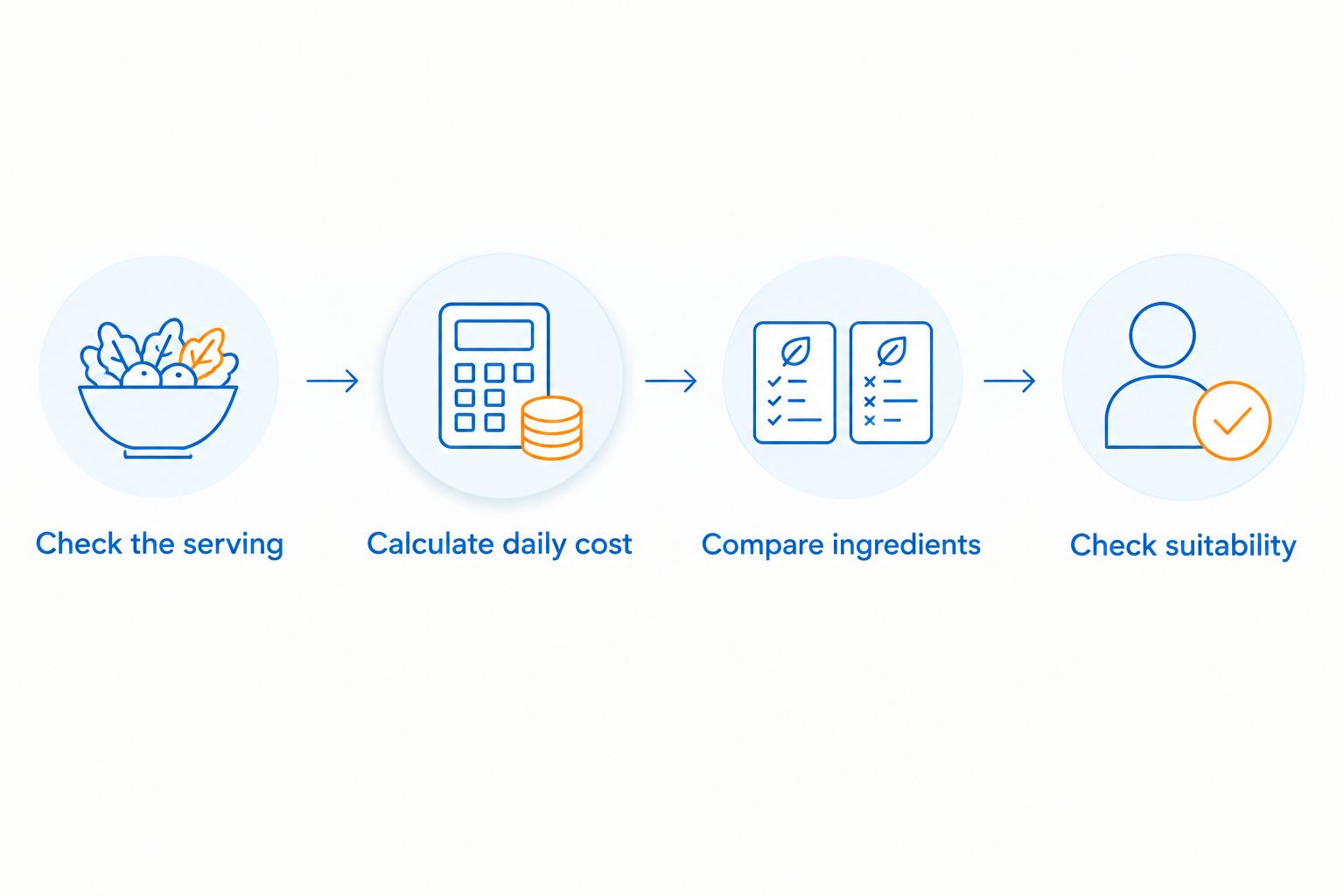
Use the same sequence for every product on your 2026 shortlist. Comparing unlike serving sizes produces a ranking that looks precise but answers the wrong question.
Check the serving
Find the serving size and servings per container. The number of gummies or capsules in the bottle is not necessarily the number of daily servings.
Calculate daily cost
Divide the current bottle total by the number of labeled daily servings it supplies. Use the same purchase conditions across products rather than mixing a recurring-order offer with a one-time purchase.
Compare ingredients
Review what each serving actually provides. A single-nutrient product and a multi-ingredient gummy do not become equivalent because their daily costs are similar.
Check suitability
Review warnings, dietary requirements, other supplements, and medicines. Remove unsuitable options before you sort the remaining choices by cost.
Keep the comparison practical. If you would not choose an ingredient without the discount, the discount is not a reason to add it to your routine.
How these recommendations are ranked
The shortlist prioritizes intended use, label clarity, safety, and evidence before cost. The gummy option addresses format preference; the nutrient options address specific nutritional needs; the botanical section addresses an unsupported tinnitus claim.
This is not a ranking of hearing improvement. No option earns a tinnitus-treatment recommendation because its bottle costs less or its ingredient list is longer.
Which ear health supplement should you choose?
Choose Tinniva ear health supplements when your goal is a gummy-based everyday wellness routine and the current label fits your needs. Choose a targeted nutrient only when you have a clear reason to take that nutrient.
If ringing or a hearing change is driving the purchase, start with a healthcare professional rather than a supplement order. Sudden hearing loss needs urgent medical assessment, not a trial of a wellness product.
For an undecided buyer in 2026, the default is simple: do not buy until you can state the product’s purpose without promising symptom relief. Then compare the cost per labeled daily serving.
Protecting hearing is a separate decision
Supplement shopping should not displace hearing protection. Reducing hazardous noise exposure addresses a risk that an ear-wellness gummy cannot cancel out.
NIOSH occupational guidance uses an exposure limit of 85 dBA over 8 hours, with recommended exposure time halved for each 3 dB increase. Those workplace limits are not a guarantee of safety for every person or situation.
Use appropriate hearing protection around loud equipment and other hazardous noise. Do not treat a supplement routine as permission to tolerate louder sound.
FAQ
What is the best way to compare ear health supplements ranked by price?
Compare the cost per labeled daily serving after checking ingredient amounts and personal suitability. Bottle totals alone do not account for different serving sizes or numbers of servings.
Are Tinniva ear health supplements a treatment for tinnitus?
Tinniva Ear Health Gummies are positioned as an everyday ear-wellness dietary supplement, not an established tinnitus treatment. Persistent or bothersome ringing deserves a separate healthcare assessment.
Is a cheaper ear health supplement better value?
A cheaper supplement is better value only if it fits your needs and provides a suitable labeled serving. An unnecessary or unsuitable ingredient remains a poor choice regardless of cost.
Should I take vitamin B12 for ringing in my ears?
Do not assume vitamin B12 treats ear ringing. B12 supplementation is appropriate for specific nutritional needs, including deficiency, while tinnitus requires its own assessment.
Are zinc and magnesium better than ear health gummies?
Zinc, magnesium, and ear health gummies serve different purposes, so none is automatically better. Choose a targeted mineral for an identified need and evaluate gummies by their actual ingredients and intended use.
Does ginkgo biloba help tinnitus?
Research does not establish ginkgo biloba as an effective tinnitus treatment. It also has interaction risks, including increased bleeding risk with anticoagulant medicines.
Can I combine an ear wellness supplement with a multivitamin?
Check both labels and ask a pharmacist before combining them. Overlapping nutrients can increase your total intake, and ingredients can interact with medicines.
One last thing
The number to write down is servings per container, not the largest number printed on the front. That simple check helps you avoid confusing more gummies, a larger ingredient amount, or a longer ingredient list with better value.